


UGA VetMed hosts second annual gathering of multi-disciplinary researchers

CVM faculty and leadership listen in to Provost Ben Ayers’ welcome.
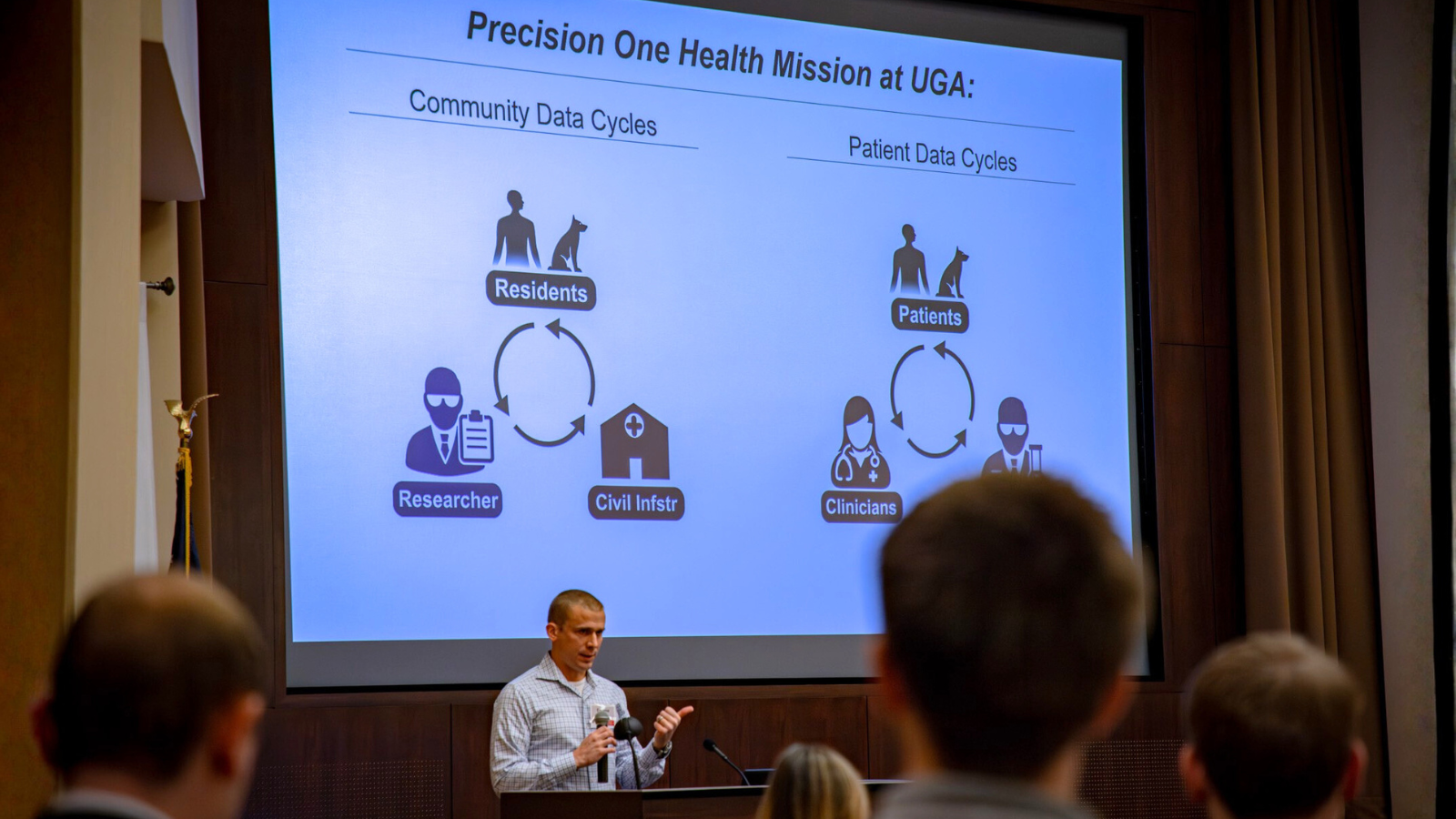
Findings in human, animal and environmental health were the talk of the second Precision One Health Initiative Symposium hosted by the University of Georgia College of Veterinary Medicine. “Converge: Building a Smarter, Healthier Future at the Intersection of one Health, Precision Medicine and AI” was held Nov. 7 at the Georgia Center.
Ben Ayers, senior vice president for academic affairs and provost, opened the conference by expressing his pride in the impact Precision One has had since its founding four years ago.
“By examining inter-connections among genetics, the environment, and lifestyle factors, researchers in Precision One Health are opening new avenues of exploration in disease prevention and also in disease treatment,” Ayers said. “The holistic One Health approach also advances our readiness for disease outbreaks and community health challenges, safeguarding individuals, public health, our food supply, agriculture, and the environment.”
Computational processes and artificial intelligence are accelerating discoveries in the program, according to several speakers, including the keynote speech delivered by Prashant Doshi, director of the new AI Institute at UGA.
AI is already speeding up the development of new drugs to treat common and uncommon diseases, a process that historically takes from 10 to 15 years and costs billions. Researchers are even using it to revisit drug formulas that didn’t work for their intended purpose but have potential against other illnesses.
The ability of AI and computerized data analysis programs to validate the efficiency of drugs at the molecular level has already saved lives. Eugene Douglass, assistant professor of pharmaceutical and biomedical sciences in UGA’s College of Pharmacy, offered an illustration of a canine patient belonging to a Precision One researcher.
The dog was diagnosed at the UGA Veterinary Teaching Hospital with a rare cancer, localized histiocytic sarcoma, commonly found in the skin, soft tissues, bone, joints and lungs. It affects both dogs and humans and carries a poor prognosis. Treatment is limited because so few cases are diagnosed.
But in this case, the veterinary oncologist suggested a commercial genomic test that sequenced the tumor and matched it to available drugs. The analysis identified a drug that could target a variant in the tumor, and the dog enjoyed a good quality life for a couple more years, Douglass said.
Precision One researchers are working on bringing the technology that made that success possible in-house for use at the teaching hospital. Together the CVM and the new school of medicine at UGA are also developing processes to test drugs directly on patient tissue using organoid technology. This form of precision medicine will allow doctors to prescribe the drug proven to be the most effective treatment for that individual.

Provost Ben Ayers brings remarks.
These initiatives and more are what set UGA apart in the Precision One Health field, according to Ayers.
“One of the defining strengths of the University of Georgia is the comprehensive nature of our research enterprise, and that is a source of pride for all of us,” he said. “With the establishment of the School of Medicine, we are now one of only 13 universities that on a single campus have schools of veterinary medicine, human medicine, and also agriculture. These three disciplines, plus our new School of Nursing, Public Health, Pharmacy, Engineering, Arts and Sciences, Law, Family and Consumer Sciences, Forestry and Natural Resources, Journalism, and Mass Communications all position UGA to make a unique impact on the holistic concept of One Health.”


