

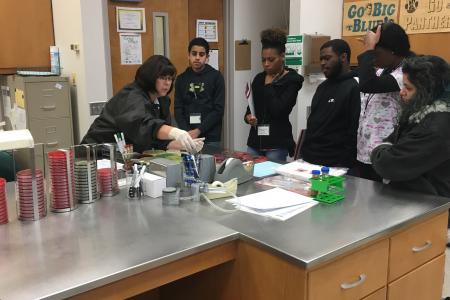
Tifton Veterinary Diagnostic Lab hosts local students for veterinary career workshop
The Tifton veterinary diagnostic laboratory recently hosted undergraduate students from Fort Valley State University and local Tift county high school students for a day-long workshop on veterinary career options.
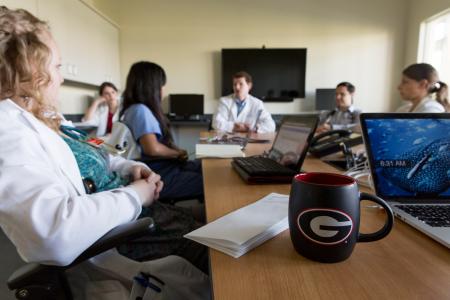
New professional master’s program offered by the College of Veterinary Medicine
The College of Veterinary Medicine at the University of Georgia has announced the formation of a one-year, non-thesis professional master’s program.
Associate professor Andrew Park conducts research that aims to predict and limit the transmission of parasites and infectious diseases while also giving students the opportunity to work alongside him in his lab.
Developing a rapid attack against parasitic worms
Preclinical compound targets Wolbachia bacteria that are essential for nematode reproduction.
Focus on Faculty: Courtney Murdock
Courtney Murdock, an assistant professor with a joint appointment in the College of Veterinary Medicine and the Odum School of Ecology, studies the transmission of mosquito-borne diseases to inform predictions about disease patterns and interventions to disrupt transmission.
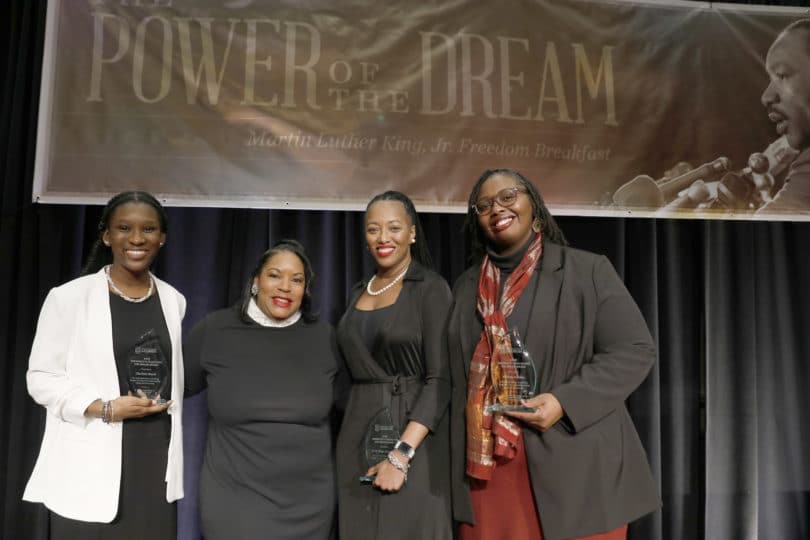
Pathology faculty member awarded UGA’s Fulfilling the Dream award
Paige Carmichael, professor of veterinary pathology, was one of three awarded the President’s Fulfilling the Dream award at the 2019 Freedom Breakfast. The award is given to people in the university and Athens community who are actively striving to make Dr. Martin Luther King, Jr.’s dreams of racial justice and […]
Naoko Uno wins UGA’s Sixth 3MT
On April 3, last year, Naoko Uno won UGA’s sixth 3MT, which is sponsored annually by the Graduate School. Uno is currently researching an infectious disease known as dengue virus. She works with a research team at UGA’s Center for Vaccines and Immunology, in hopes of creating a universal vaccine. She is also an avid musician and vocalist.
Dr. Pejman Rohani Named as a UGA Athletic Association Professor
Four faculty members have been named University of Georgia Athletic Association Professors in recognition of their extraordinary records of scholarship, instruction and outreach.
Focus on Faculty: Hemant Naikare
Hemant Naikare, director of the Georgia Veterinary Diagnostic and Investigational Laboratory in Tifton, is committed to introducing students—in 4-H, middle school, high school and at the undergraduate level—to the field of veterinary medicine.
Maria Lay Mendoza awarded GAIN Fellowship Award
Maria Lay Mendoza is a CBS MS student in Dr. Brindley's lab. She was awarded one of the Graduate School's fellowships, called GAIN.


